 arielwp@yahoo.com
 arielwp@yahoo.com


POSTCARD Moshe Valdersky Bnei Brak 1932
POSTCARD Moshe Valdersky Bnei Brak 1932
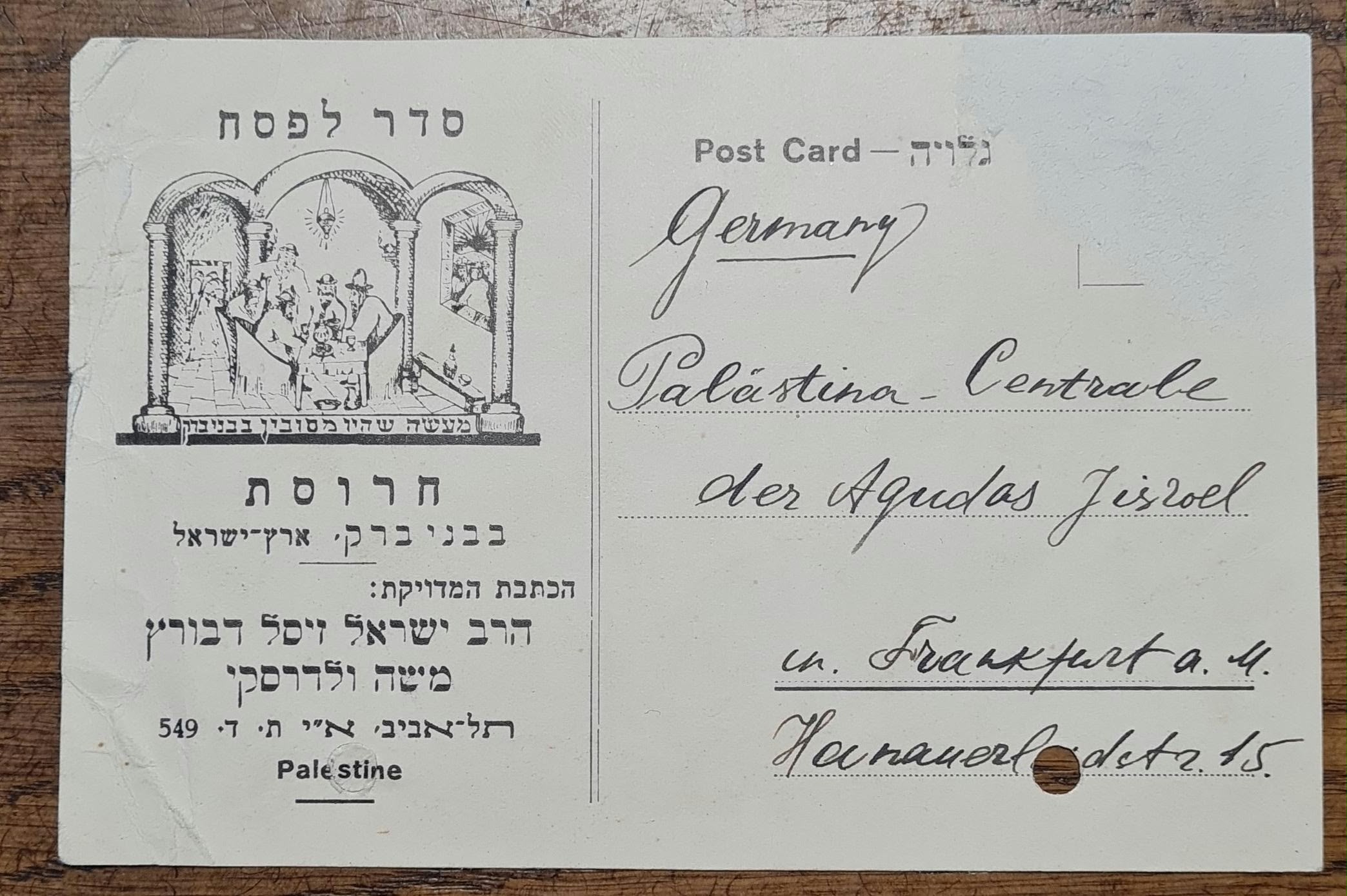
A Bnei Brak Charoset Postcard to Frankfurt, 1932
Written and signed by Moshe Valderski · Bnei Brak / Tel Aviv, 1932 · Sent to the Palästina-Centrale of Agudath Israel in Frankfurt
At first glance, this small postcard appears to be a charming advertisement for charoset. In fact, it preserves a little piece of the story of the building of Jewish life in Eretz Israel.
The illustrated side announces charoset from Bnei Brak, Eretz Israel, accompanied by the familiar words of the Haggadah:
“מעשה שהיו מסובין בבני ברק” — “It happened that they were reclining in Bnei Brak.”
Printed beneath are the names of Rabbi Israel Zissel Dvoretz and Moshe Valderski, together with their Palestine address.
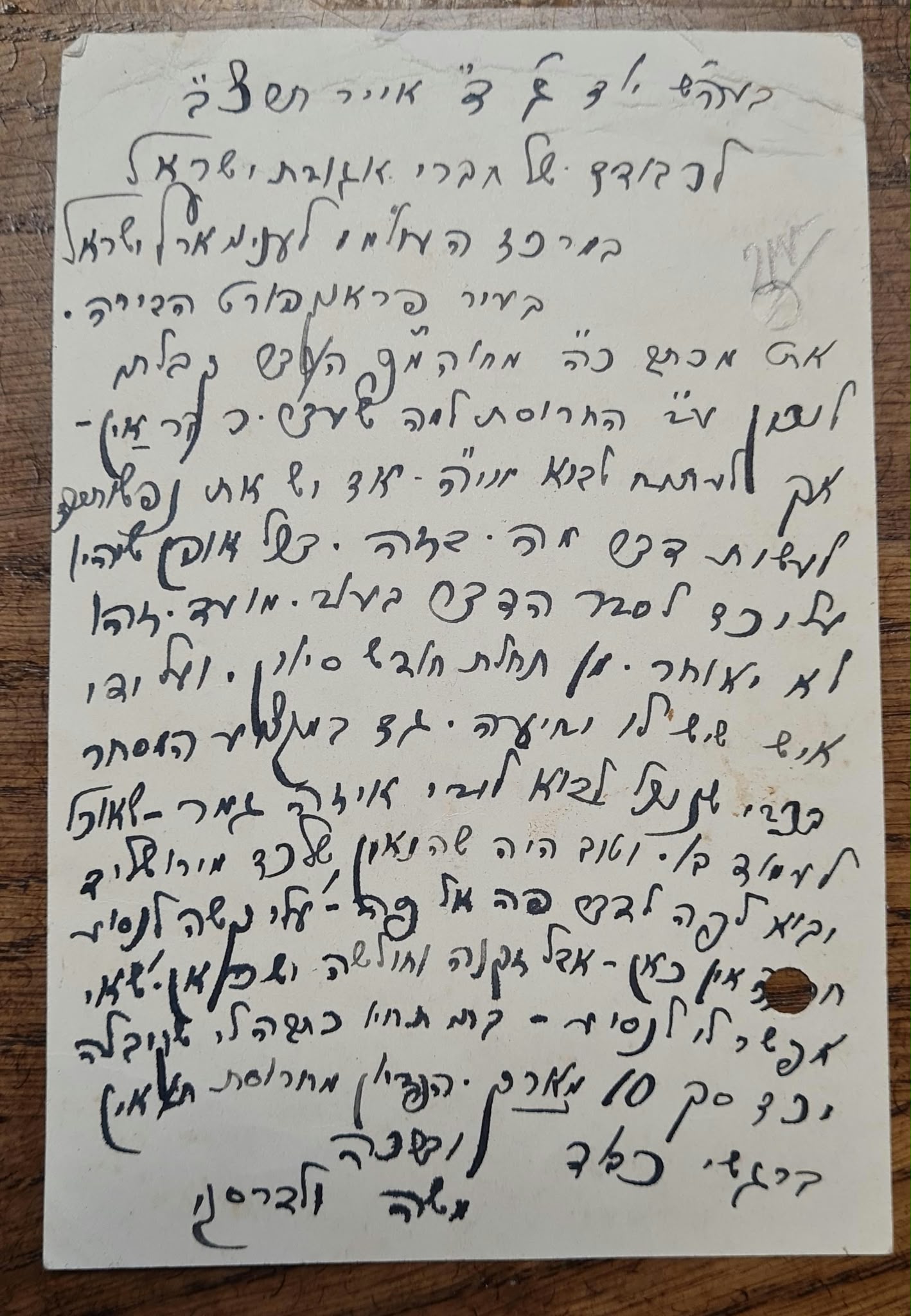
The reverse transforms the advertisement into a historical document. On 6 Iyar 5692 — 12 May 1932, Moshe Valderski wrote and signed the postcard himself, addressing it to the Palästina-Centrale der Agudas Jisroel, the Palestine office of Agudath Israel in Frankfurt am Main.
His handwritten message concerns the practical business of bringing Bnei Brak charoset to European Jews. He acknowledges receiving their earlier letter and discusses the charoset, an advertising prospectus, shipment of the merchandise, pricing by kilogram, and expenses, including a sum of ten German marks.
Valderski was no ordinary food merchant. Historical records identify him as one of the early founders of Bnei Brak, an immigrant from Kremenchug who began a new life in the developing Jewish settlement. He established a factory devoted to producing charoset suitable for shipment not only within Palestine but also to Jewish communities abroad.
The enterprise received remarkable rabbinic support. Rabbi Abraham Isaac Kook wrote approvingly of Valderski’s charoset and connected support for such locally produced goods with strengthening Jewish settlement in the Land of Israel. A later Jerusalem rabbinical document described the effort and expense required to develop charoset capable of surviving long journeys by land and sea.
The other name printed on the card, Rabbi Israel Zissel Dvoretz, belonged to an important Lithuanian Torah scholar and communal builder. A disciple of the Slabodka world, he later devoted himself to yeshivot, schools, Torah publishing and Jewish communal life in Eretz Israel. His involvement gives the little enterprise an additional dimension: the production and distribution of charoset was connected to a wider world of religious and communal rebuilding.
And the overseas ambition was real. Surviving correspondence from later in the decade records charoset from the Bnei Brak enterprise reaching Jews as far away as London.
It is tempting to imagine that Valderski deliberately chose charoset because its ingredients could encourage the agriculture of the growing Jewish settlement. The product was deliberately promoted as charoset made in Eretz Israel, and contemporary supporters understood the enterprise as part of strengthening Jewish life and industry there.
That is what makes this postcard particularly evocative.
A Jewish entrepreneur in the still-young Bnei Brak was writing to Frankfurt not simply to sell a jar of charoset. He was trying to place something made in Eretz Israel onto the Seder tables of Jews in Europe.
Only a few years later, the Jewish world of Frankfurt would face catastrophe. But in 1932 this postcard still carries the optimism of another moment: Bnei Brak was being built, Jewish agriculture and industry were growing, and a man named Moshe Valderski was arranging the price, printing and shipping required to send a small taste of the Land of Israel across the sea for Pesach.
The postcard is therefore both an advertisement and a surviving piece of the business correspondence behind it—a modest document from the years when the new Jewish towns of Eretz Israel were beginning to reach outward to the Jewish world.
SPECIAL
ISRAEL


