 arielwp@yahoo.com
 arielwp@yahoo.com


Yudlov 543 Haggadah Vienna 1813 2
Yudlov 543 Haggadah Vienna 1813 2
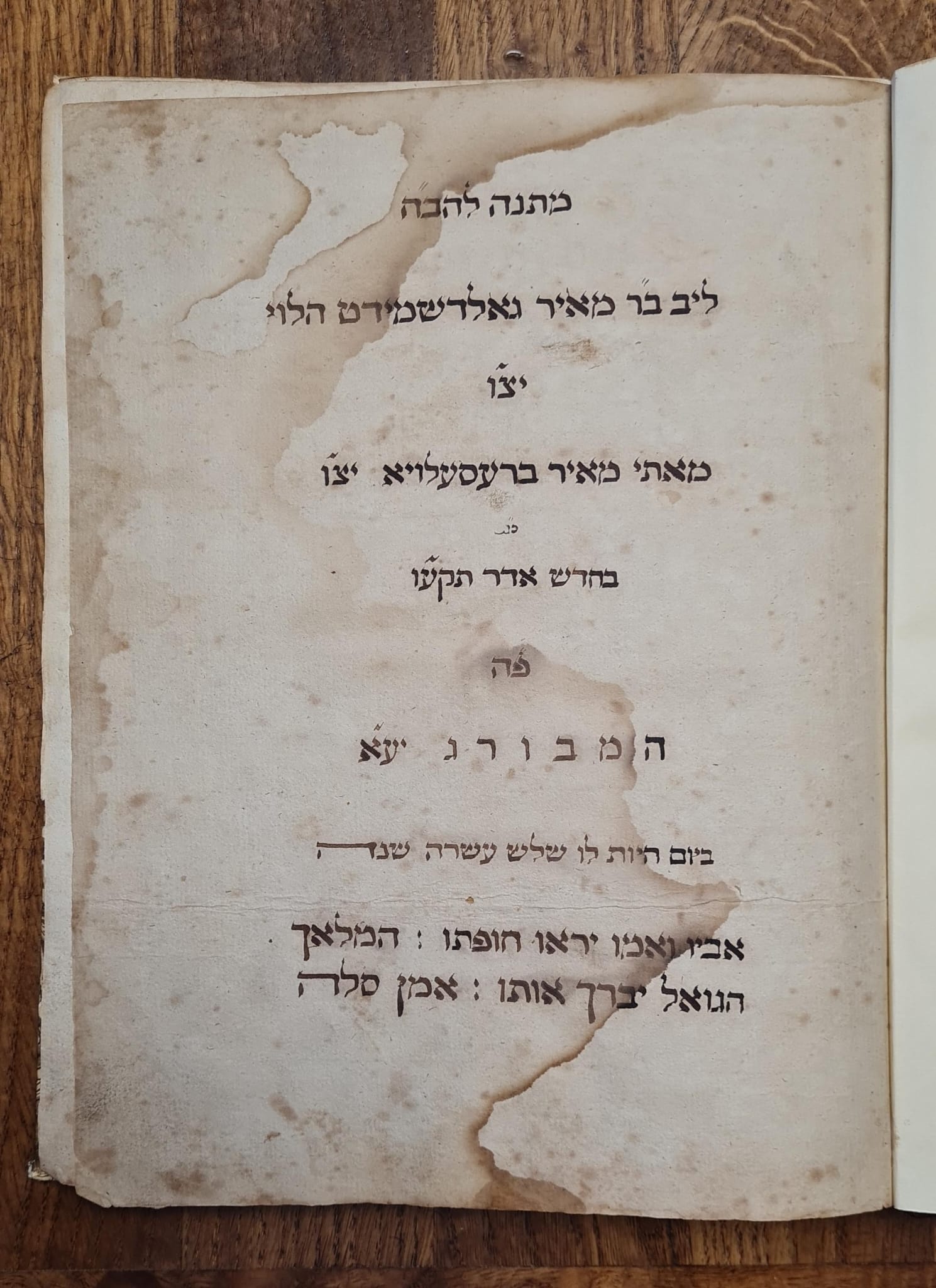
This Haggadah has a handwritten presentation inscription on the opening page, written in 1816 in Hamburg, Germany, during the early post-Napoleonic era. Translated from the Hebrew, the dedication reads:
“A gift for the future. To Leib, son of Mr. Meir Goldschmidt, the Levite (May his Creator guard and protect him). From me, Meir Breslau (May his Creator guard and protect him). In the month of Adar, 5576 [February/March 1816], here in Hamburg (May the Almighty protect it). On the day he reached thirteen years of age. May his father and mother witness his wedding canopy; May the redeeming angel bless him; Amen Selah.”
Because Jewish law marks a boy’s Bar Mitzvah at age thirteen, this text confirms that Leib Goldschmidt was born into a Levite family in Hamburg in the Hebrew month of Adar, 5563 (February or March of 1803).
The gift-giver, signed as Meir Breslau, is very, very likely Meyer Israel Bresselau (1785–1839). He was a sofer, scholar, and one of Hamburg’s first Jewish notary publics.
Just one year after writing this inscription, in 1817, Bresselau became a primary intellectual architect and co-founder of the Israelitischer Tempelverein (The Hamburg Temple Association). In 1819, he co-edited and published Seder ha-Avodah (The Order of Service), which historians recognize as the first comprehensive Reform prayer book ever printed. When traditional Orthodox rabbinic authorities banned the new liturgy, Bresselau authored the famous 1819 Hebrew satire Cherev Nokemet Nekam Berit to textually and legally defend the Reform movement.
Connecting the Families: Facts and Hypotheses
The presence of both the Bresselau and Goldschmidt names on this page highlights the social dynamics behind the birth of Reform Judaism.
-
- Confirmed Facts: Bresselau’s Reform Temple project relied heavily on the financial and political backing of Hamburg’s banking aristocracy. Members of the prominent Goldschmidt family were among the earliest signatories, underwriters, and board members who funded Bresselau’s temple and subsidized his 1819 prayer book.
- Unconfirmed Hypothesis: Period records show that Meyer Israel Bresselau’s sister, Reichel, married into the Hamburg Goldschmidt family. It is even possible that young Leib was Bresselau’s nephew or a close cousin by marriage, making this an affectionate family gift. However, without a definitive birth registry or family tree linking Leib ben Meir directly to this specific household, this exact familial connection remains a plausible theory rather than an absolute certainty.
Ultimately, this Haggadah captures a traditional presentation gift from a Hebrew Scholar to a young member of an elite family, recorded just months before Rabbi Bresslau and the Goldsmith families initiated a liturgical and religious revolution.

SPECIAL


