 arielwp@yahoo.com
 arielwp@yahoo.com


ICRC Central Prisoners of War Agency Message form Poland 1940
International Committee of the Red Cross, Central Prisoners of War Agency Message form Poland 1940
Wartime Correspondence: The Schueck Family of Lubaczów
-
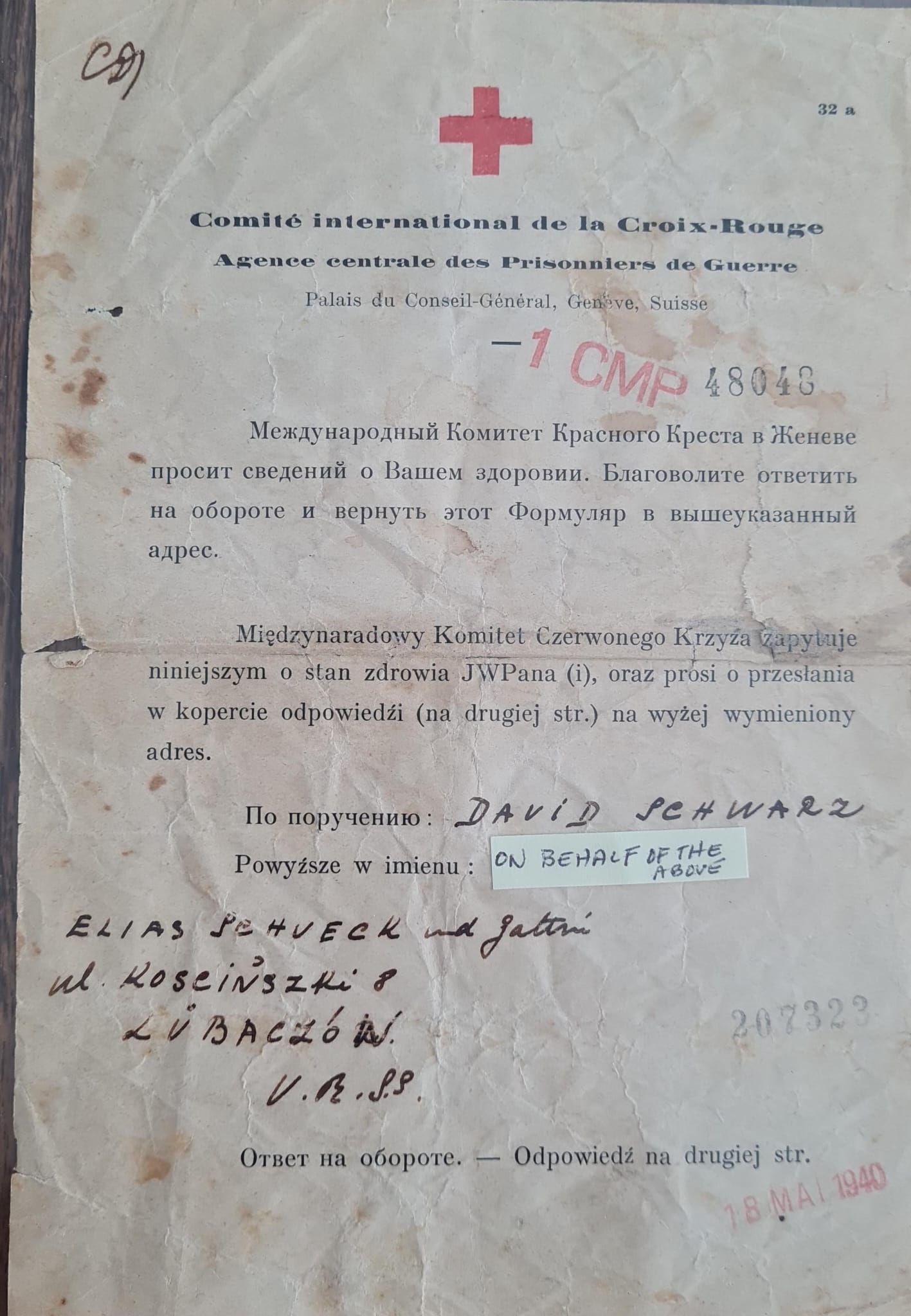
- Document Type: International Committee of the Red Cross (ICRC) Central Prisoners of War Agency Message Form.
- Date of Registration: May 18, 1940 (Geneva, Switzerland).
- The Inquirer: David Schwarz, acting abroad on behalf of the children of the recipients.
- The Recipients: Elias Schueck and his spouse (“Elias Schueck und gattin”), residing at ul. Kościuszki 8, Lubaczów, Poland.
The Message and Chronology
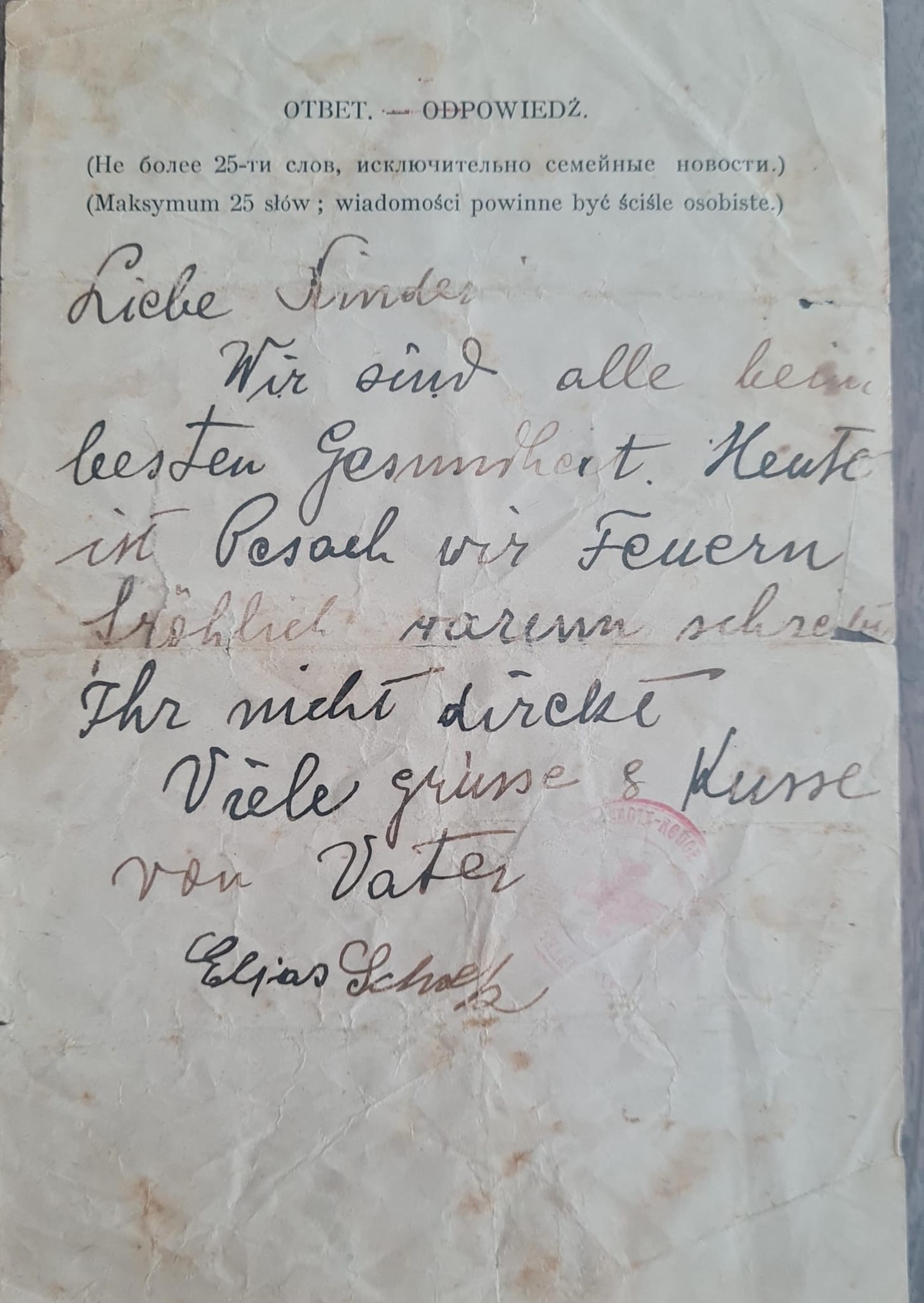
The front of this form represents a standardized inquiry routed through neutral Switzerland to check on the health of relatives isolated by World War II. The reverse side contains a direct response handwritten in German by Elias Schueck, signing as “Vater” (Father) to his “Kinder” (Children):
“Dear Children, We are all in the best of health. Today is Pesach [Passover], we are celebrating happily. Why do you not write directly. Many greetings & kisses from Father — Elias Schueck.”
The reference to Passover fixes the composition of the letter to the week of April 22–30, 1940. A faint pink Soviet censorship stamp confirms the mail safely passed through the Soviet administration occupying southeastern Poland at that time before reaching Geneva in May.
The Passover Context
Writing during Passover (Pesach) introduces a profound layer of historical significance to the document. The holiday fundamentally celebrates liberation from slavery and survival against oppressive regimes. By writing that they were celebrating “happily,” Elias emphasizes the preservation of faith, family ties, and optimism. Under Soviet rule in April 1940, the family experienced a brief, false sense of security—unaware that the window for physical escape was closing and that the traditional narrative of liberation would soon be tragically reversed by the oncoming German invasion.
Historical Fate & Survival Analysis
This correspondence stands as the final verified point of contact for Elias Schueck and his wife.
-
- The Statistical Reality: Following the Nazi invasion of the region in June 1941, a sealed ghetto was established in Lubaczów in October 1942. The ghetto was violently liquidated between January 6 and January 8, 1943, with the vast majority of the population deported to the Belzec extermination camp or shot in the nearby Dziki Bór forest. Fewer than 100 Jewish residents of Lubaczów survived the occupation.
- The Probability of Reunion: Extensive queries of the Arolsen Archives, Yad Vashem survivor registries, and postwar Displaced Persons (DP) manifests yield zero entries for Elias Schueck or his spouse. Given a localized survival rate of under 2% and the total absence of postwar records, the statistical probability that Elias and his wife survived to see their children again is minimal. This document remains the final surviving artifact of their lives and their last words to their family.
SPECIAL
HOLOCAUST
IRONID


